Salar de Tara
Salar de Tara
High-altitude salt lake at 4,300 m, Salar de Tara combines eroded volcanic formations, bofedales and Andean wildlife, 150 km from San Pedro de Atacama.
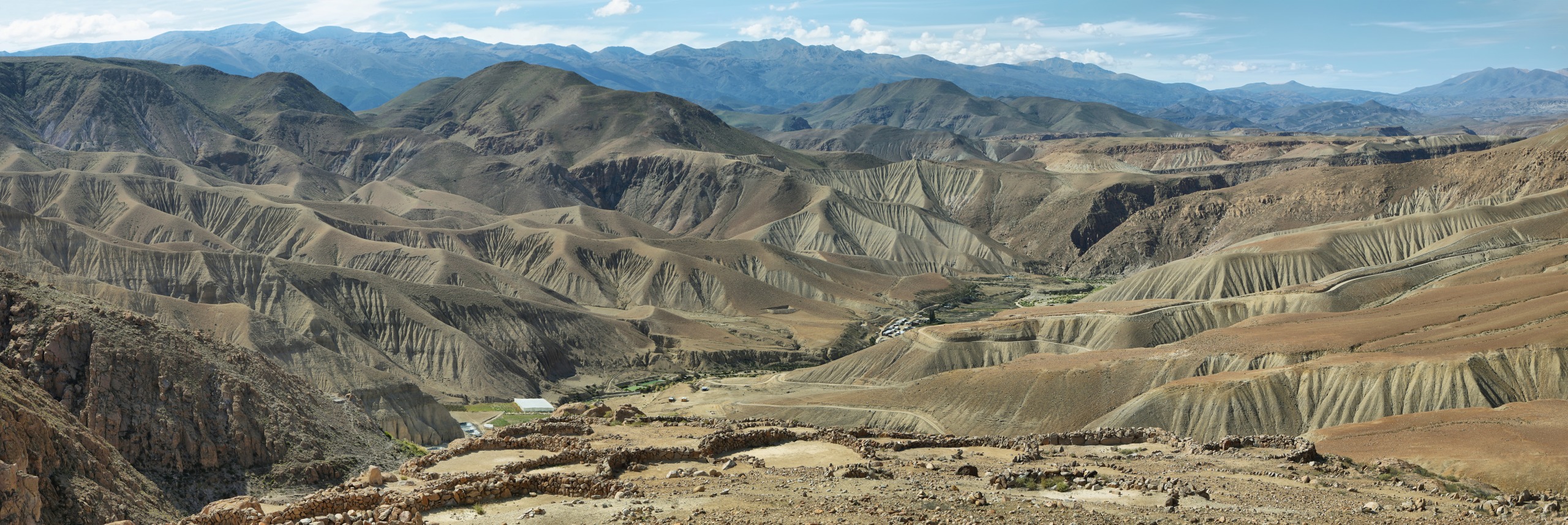
Salar de Tara is a high-altitude salt lake located in the Los Flamencos National Reserve, in northern Chili, near the tripartite border between Chili, Argentina and Bolivia. At 4,300 m altitude and approximately 150 km west of San Pedro de Atacama, it combines salt flats, rock formations carved by erosion and Andean wildlife.
Why visit Salar de Tara
The site brings together several landscapes characteristic of the Chilean altiplano in a restricted area: a salt flat bordered by bofedales (high-altitude wetlands), eroded volcanic reliefs and easily visible wildlife. It receives fewer visitors than Salar de Atacama due to more demanding access. This relative isolation preserves the wild character of the place and increases chances of spotting vicuñas, guanacos and flamingos.
Geological history of the site
The Salar de Tara basin belongs to a volcanic complex that has been active for several million years. Cathédrale de Tara, a long rocky ridge with sculpted walls, corresponds to the remains of an ancient volcanic caldera. Wind erosion and marked temperature fluctuations have shaped the columns and silhouettes that punctuate the area. The salt lake itself formed through salt accumulation in an endorheic basin, fed mainly by the Zapaleri river descending from the north. Its surface area is estimated at around 48 km².
What to see on site
Monjes de la Pacana
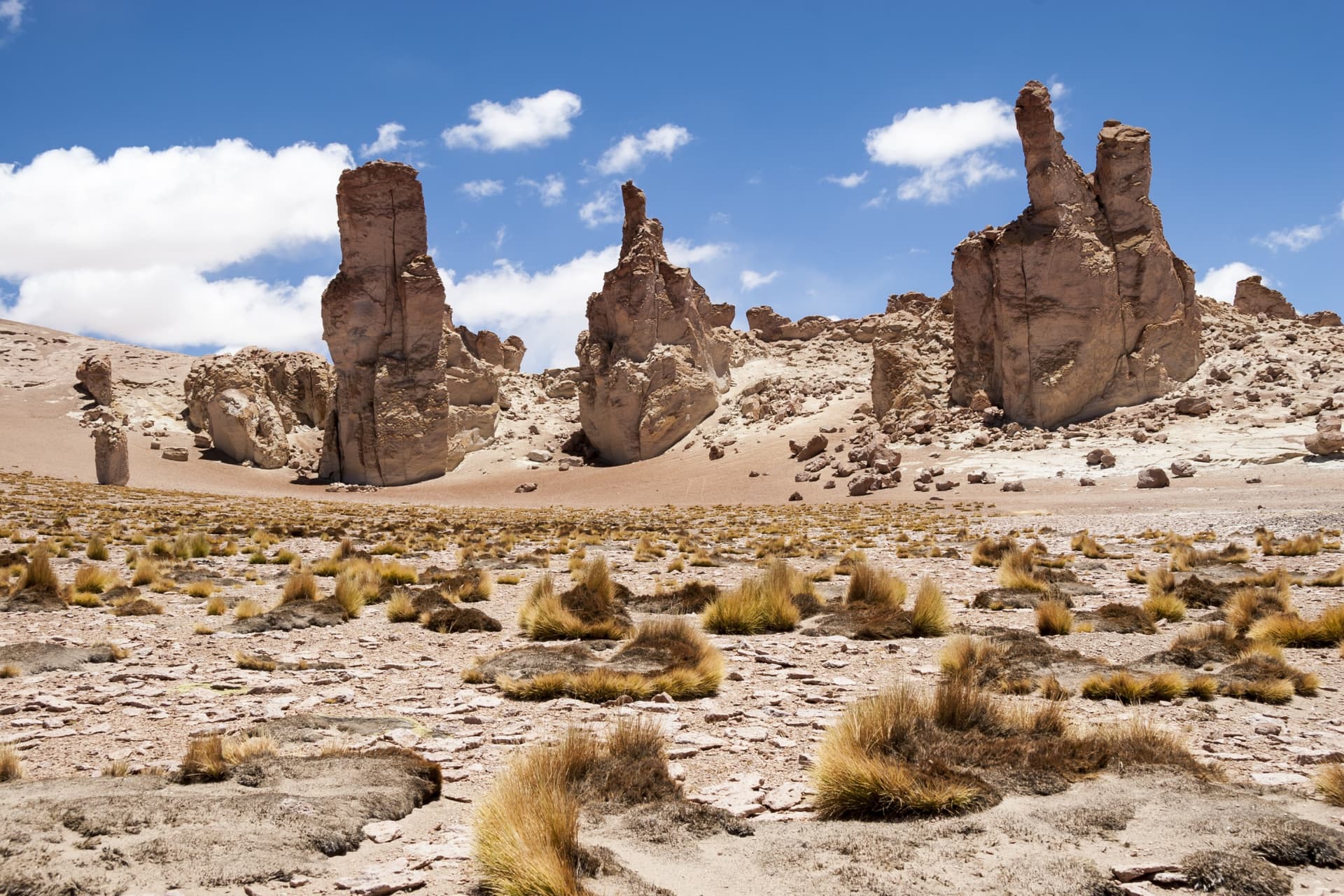
Along the approach route stand the Monjes de la Pacana, also called Moais of Tara: isolated rock columns whose silhouettes evoke human figures. These formations result from differential erosion of ancient volcanic deposits.
Cathédrale de Tara
Further on, Cathédrale de Tara forms a rocky wall with vertical cuts. The site marks the location of an ancient caldera and is one of the most striking viewpoints in Los Flamencos National Reserve.
Salar de Aguas Calientes
Near Salar de Tara, Salar de Aguas Calientes features waters with varying hues that feed flamingo colonies. Both areas are often visited in the same day.
Wildlife and flora
- Flamingos (three Andean species present in the reserve)
- Vicuñas in scattered herds
- Magellanic foxes
- Llamas and guanacos, sometimes equipped with colorful textiles indicating their belonging to a local herder
- Bofedales and paja brava tufts on the slopes
Practical information
Salar de Tara is generally visited as a day trip from San Pedro de Atacama. The altitude (4,300 m) requires some precautions: plan prior acclimatization of several days in the region, stay well hydrated and avoid sustained exertion. Solar radiation is intense, so filtering sunglasses, a hat and high-protection sunscreen are essential. Temperature swings are significant: bring warm layers even in the austral summer.
Entry to Los Flamencos National Reserve is charged (moderate fee, paid on-site). Allow a full day for the visit, including transfers.
When to go
The climate is high-altitude desert, with a strong difference between daytime and nighttime temperatures year-round. The best conditions are generally observed from October to December, when tracks are passable and temperatures milder. Austral winter (July-August) offers clear skies but very cold nights and higher tourist numbers. Snow or rain episodes can close the access track in summer (January-February, during the "Bolivian winter").
How to get there
From San Pedro de Atacama, the international route toward Argentina via Jama Pass leads to the site access point. After approximately 102 km of paved track, an unmarked turnoff gives access to Salar de Tara: it must be registered in advance on a GPS. The remainder of the journey is on soft earth, following vehicle tracks. A 4x4 is necessary beyond the asphalt road. Plan approximately 3 hours of driving from San Pedro de Atacama.
Most travelers book an organized 4x4 excursion from San Pedro de Atacama, which simplifies logistics and provides support at altitude.
Nearby attractions
- Salar de Atacama: the region's largest salt lake, more accessible and at lower altitude.
- Salar d'Uyuni: natural extension on the Bolivian side, accessible via Jama Pass.
- Thermes de Polloquere: high-altitude hot springs in northern Chili.
Frequently asked questions
Frequently asked questions
Yes. At 4,300 m altitude, acute mountain sickness can occur. It is recommended to spend at least 2 to 3 nights in San Pedro de Atacama (2,400 m) or to visit other sites at intermediate altitude first before ascending to Tara.
No. The paved road goes to the access point, but the final stretch, on soft earth and unmarked, requires a 4x4 and a GPS with pre-registered coordinates.
Plan a full day from San Pedro de Atacama: approximately 3 hours driving each way, and 2 to 3 hours on-site to explore Monjes de la Pacana, Cathédrale de Tara and the salt lake surroundings.
Flamingos are present year-round in the Salar de Aguas Calientes area. Observation is easier between October and December, when the climate is more stable.
A guided excursion is recommended for most travelers: access is unmarked, off-road driving requires experience, and a local guide provides support in case of altitude-related symptoms.
Plan your trip
Salar de Tara fits naturally into a circuit in northern Chili combining the Atacama desert, altiplano and Andean villages. To build a complete itinerary, explore our Chili tours.
Interested in this visit?
We can include it in your personalised itinerary.