The Giant of Tarapacá
The Giant of Tarapacá
Carved into the slope of Cerro Unita near Huara, the Giant of Tarapacá rises to 115 m and is believed to be the world's largest anthropomorphic geoglyph.
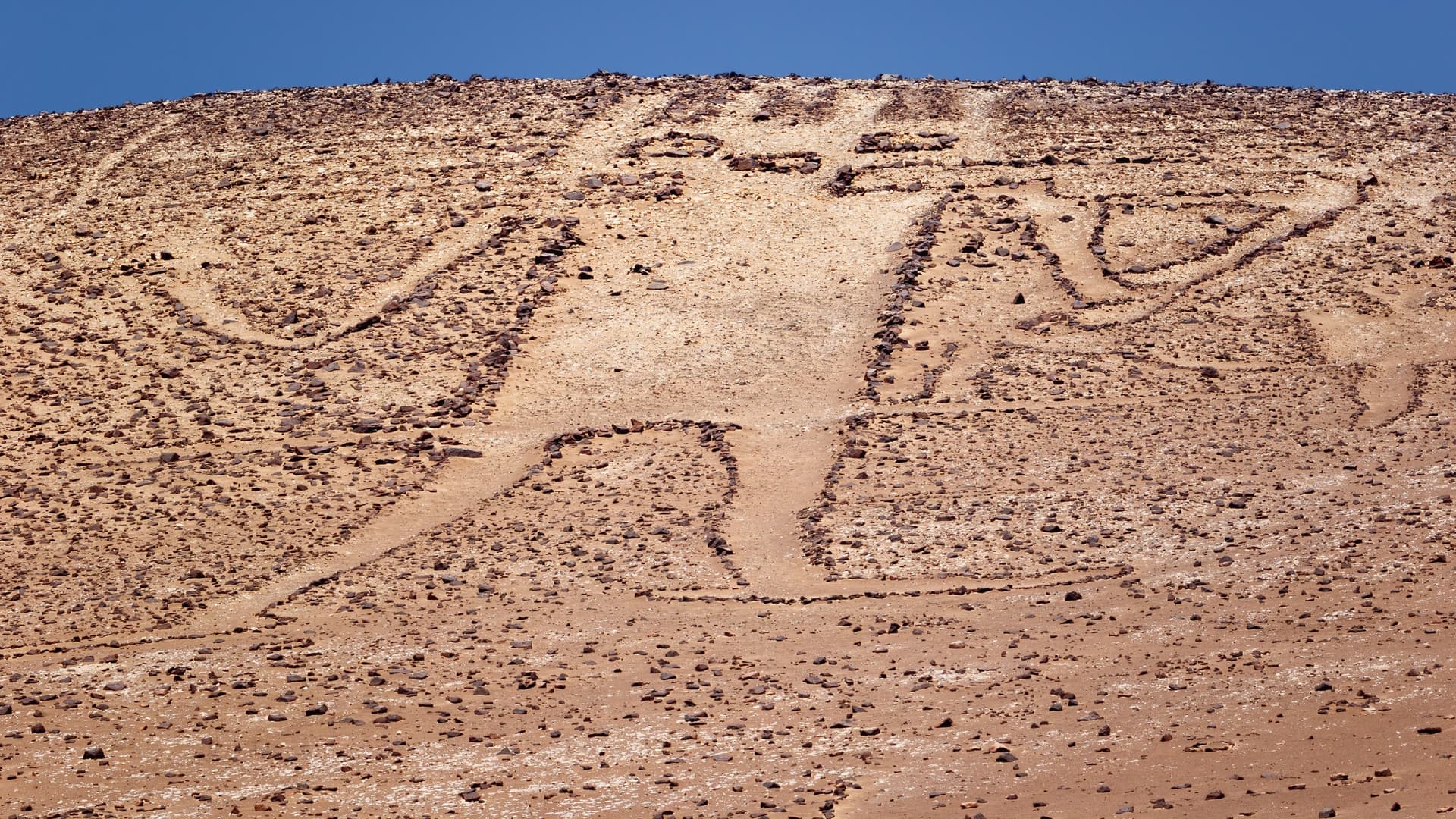
The Giant of Tarapacá, also called the Giant of Atacama, is carved into the slope of Cerro Unita, approximately 15 km northwest of Huara, in the Atacama Desert. At 86 meters tall (115 meters including the crown) and covering nearly 3,000 m², it is considered the world's largest anthropomorphic geoglyph.
Why visit the Giant of Tarapacá
The site combines several rare interests in one location:
- A monumental humanoid figure, unique in scale among known geoglyphs.
- Direct testimony to pre-Hispanic Andean cultures in northern Chili, dating from before the later Inca conquest.
- A high-altitude desert environment that enabled its preservation for several centuries.
- Multiple interpretations—religious, astronomical, mythological—that continue to fuel archaeological research.
The Giant is part of a larger ensemble: over 5,000 geoglyphs are recorded in the region, mainly depicting animals and human figures, making northern Chili one of the world's densest zones for this type of rock art.
History and interpretations
Archaeologists date the Giant's creation to between 900 and 1450 CE, created by communities settled in the Atacama Desert. The technique involves removing or adding dark stones to make a design stand out against the light-colored slope.
Several interpretations coexist:
- A shaman or yatiri. The figure may represent an Aymara spiritual guide, capable of invoking spirits and healing. The square head is believed to be inspired by a jaguar mask, an animal of power in Andean cosmologies, and the crown of straight lines evokes ceremonial headdress.
- The deity Tunupa. According to legends linked to Lake Titicaca, the Giant may represent Tunupa, an Andean divinity who traveled from the lake to the Pacific Ocean.
- An astronomical calendar. The orientation and position of the geoglyph may allow tracking of moon movements and coordination of agricultural cycles in an area where rainfall is scarce and land infertile.
- An extraterrestrial figure. A more marginal but persistent hypothesis, fueled by the unusual silhouette and apparent antennae at the top of the head.
What you see on site
The geoglyph can be viewed in its entirety from the base of the hill. The figure is intentionally schematic: square head, elongated body, straight limbs, without striving for realism. What strikes you is the scale, more than the detail.
A few elements to observe:
- The radiating crown above the head, which adds nearly 30 meters to the total height.
- Lateral patterns and lines accompanying the main silhouette, sometimes interpreted as ritual instruments.
- The contrast between displaced dark stones and light-colored ground, making the design legible from kilometers away.
- Other secondary geoglyphs visible in the area, notably geometric and animal figures.
Plan for approximately 30 minutes to 1 hour on site to explore the area, plus travel time from Huara or Iquique.
Practical information
- Free access: the site is unfenced and visits are free, with no ticketing or fixed hours.
- Site respect: it is strictly forbidden to walk on the geoglyph or on the hillside. Viewing is done from the base, at a distance.
- Equipment: hat, sunglasses, sunscreen, plenty of water, covering clothing. UV radiation is intense at altitude.
- No services on site: no water, food, restrooms, or shade. Bring everything from Iquique or Huara.
- Limited mobile network: download offline maps before departing.
When to go
The region has a high-altitude desert climate, with significant temperature swings between day and night and very intense midday sun.
- October to December: most comfortable period, with moderate temperatures and generally clear skies.
- July to August (austral winter): viable alternative, cool but sunny days, cold nights.
- January-February: avoid during "Bolivian winter," a phenomenon of brief but sudden rains that can make dirt roads impassable.
- Recommended hours: early morning or late afternoon, when low-angle light emphasizes the geoglyph's relief and heat is more manageable.
How to get there
The Giant of Tarapacá is generally reached from Iquique, on the Pacific coast, or from Colchane, at the Bolivian border.
- From Iquique: approximately 1.5 to 2 hours by road. You follow Ruta 5 northward, then turn toward Huara, before a final stretch of a few kilometers on soft earth to the base of Cerro Unita.
- From Colchane: longer journey on paved road across the altiplano, with the same final unpaved stretch.
- Vehicle: a regular car suffices in dry season, but a 4x4 is more comfortable for the last kilometer.
- Without a car: the simplest option is an organized tour from Iquique, often combined with other sites in the region.
What to combine in the region
The Giant of Tarapacá fits well into a broader itinerary in northern Chili:
- The Azapa Valley, near Arica, for its Chinchorro mummies and coastal geoglyphs.
- The Lauca National Park, on the altiplano, with lagoons and volcanoes above 4,000 meters.
- The Los Flamencos National Reserve, around San Pedro de Atacama.
- The El Tatio geysers, to complete your Atacama discovery.
Planning your trip
To include the Giant of Tarapacá in a tailor-made circuit in northern Chili, explore our trips to Chili and connect with our specialists to build an itinerary suited to your interests.
Interested in this visit?
We can include it in your personalised itinerary.