Siloli Desert
Siloli Desert
Arid plateau at 4,500 m altitude visited from San Pedro de Atacama: colored lagoons, Stone Tree, Sol de Mañana geysers and Andean wildlife.
The Siloli Desert stretches across southern Lípez in Bolivia, at approximately 4,500 meters altitude, in close proximity to the Chilean border. Although geographically located in Bolivia, it ranks among the flagship excursions departing from San Pedro de Atacama in northern Chili: most 4x4 circuits cross the Hito Cajón border post to reach the Eduardo Avaroa National Reserve of Andean Fauna, of which Siloli is part.
Why visit the Siloli Desert from Chili
Siloli is a high arid plateau swept by winds, perched more than 4,000 meters above sea level. The ground mixes sand, salts and minerals in ochre, white and rust tones, against a backdrop of volcanic mountain range. For travelers departing from San Pedro de Atacama, it's the opportunity to chain together in two to three days Andean high-altitude landscapes, from Andean lagoons to geysers, all the way to the Salar d'Uyuni.
The sector belongs to the Eduardo Avaroa National Reserve of Andean Fauna, created to protect fragile biodiversity. The crossing is always done in a 4x4 with driver, due to lack of infrastructure on site.
What to see in the Siloli Desert
The Stone Tree
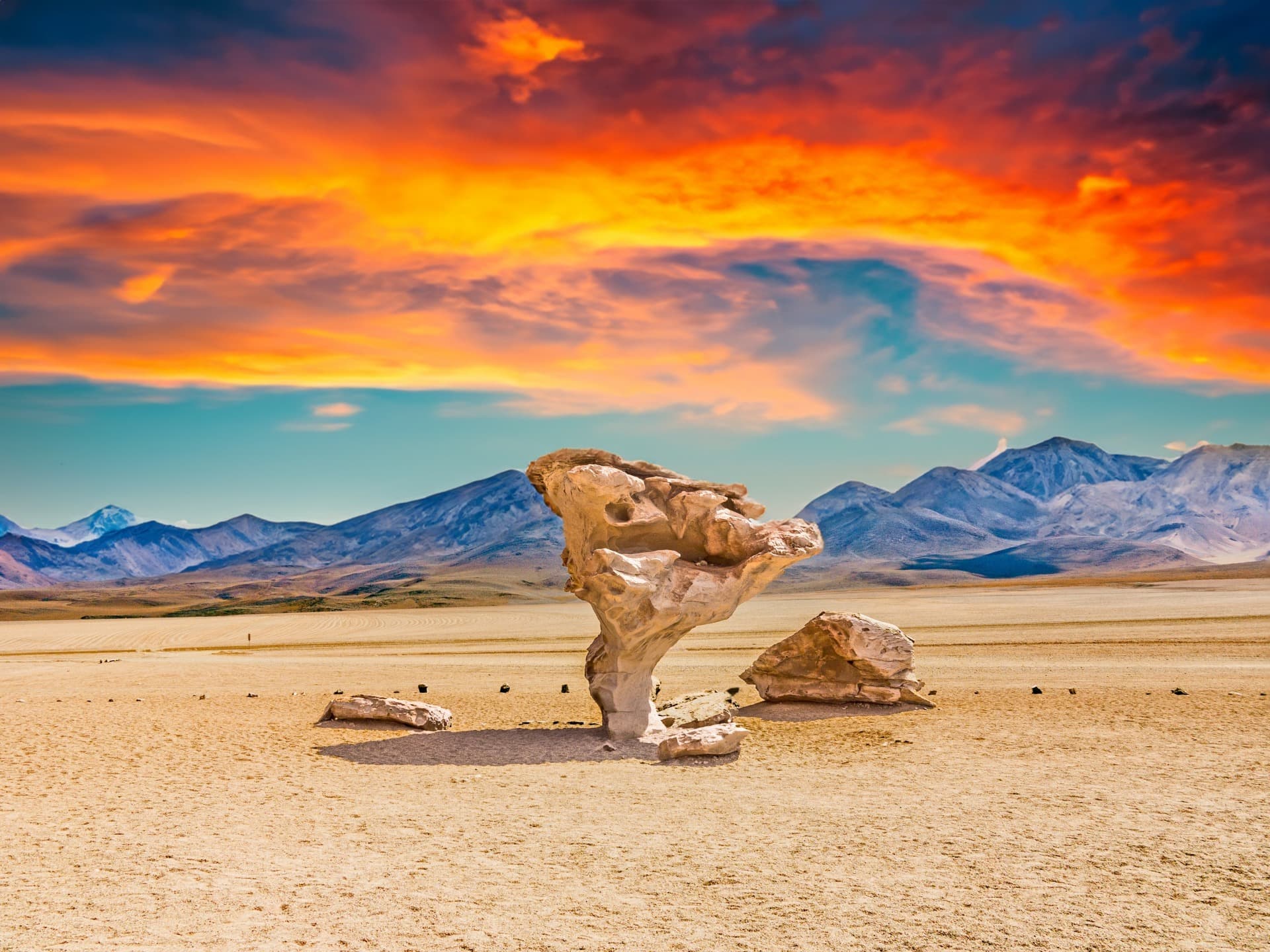
This isolated formation in the middle of a sandy plain is a block of solidified lava sculpted by wind, whose silhouette evokes a trunk topped with a crown. It's one of the most photographed stops of the crossing.
High-altitude lagoons
Several salt lakes dot the route, each with its own coloring linked to sediments and microorganisms:
- Laguna Colorada: a red lagoon inhabited by pink flamingos (James, Andean and Chilean species), whose tint comes from carotenoid pigments present in sediments and microorganisms.
- Laguna Verde: expanse of a green hue turning turquoise when wind stirs the mineral-rich sediments. It is dominated by the Licancabur volcano, which rises to 5,916 meters and marks the border with Chili.
- The Dali Desert: plain named after Salvador Dalí for its isolated rocks against a backdrop of pastel mountains, reminiscent of his surrealist paintings.
Sol de Mañana geysers
At nearly 5,000 meters altitude, this geothermal field ejects steam and makes mud pots bubble at more than 80°C. Visits take place early in the morning, when the thermal contrast with the glacial air makes the activity more spectacular.
Andean wildlife
Despite aridity, several endemic species inhabit the plateau: Andean fox, viscacha (rock rodent), Darwin's rhea and guanacos. They feed partly on ichu, a clump of short grass that grows between stones.
When to go
The dry season, from May to October, offers clear skies and good visibility, but very cold nights: it's not uncommon to drop from 25°C during the day to -15°C at night, especially in June and July. The rainy season, from November to April, brings storms and possible snowfall at altitude; some trails become difficult, but the neighboring Salar d'Uyuni then becomes covered with a reflective layer of water.
How to get there
From Chili, the usual starting point is San Pedro de Atacama. Local agencies offer 3-day / 2-night circuits that cross the border at Hito Cajón, traverse Laguna Verde, the Dali Desert, Siloli and Laguna Colorada, before reaching Salar d'Uyuni. Vehicles are shared 4x4s (6 passengers), driven by Bolivian drivers.
It is also possible to arrive from Uyuni, in Bolivia, by driving the circuit in the opposite direction. Bring your passport and cash payment (bolivianos or Chilean pesos) for reserve entrance taxes.
Practical information
- Altitude: between 4,000 and 5,000 meters depending on the sites. Prior acclimatization at San Pedro de Atacama (2,400 m) is highly recommended to limit acute mountain sickness.
- Equipment: very warm clothing (down jacket, hat, gloves), spare sleeping bag, headlamp, category 4 sunglasses, high-protection sunscreen, lip protection.
- Accommodation: very basic lodges on the edge of Laguna Colorada or at San Juan, without heating and with limited water and electricity.
- Money: no ATMs in the area, plan for cash for taxes, tips and beverages.
- Health: stay hydrated, eat light the first few days and report any persistent symptoms (headaches, nausea) to the driver.
Nearby
The Siloli circuit is part of a cluster of attractions spanning northern Chili and southern Lípez in Bolivia:
- The Tatio geysers, another geothermal field at over 4,300 meters, accessible directly from San Pedro.
- The Los Flamencos National Reserve, which includes the Salar d'Atacama and several lagoons inhabited by flamingos.
- The Lauca National Park, further north, to extend the high-altitude landscape experience.
- On the Bolivian side, the villages of San Pedro de Quemes and San Pablo de Lípez, witnesses to Andean architecture and Potosí's mining past.
Frequently asked questions
Frequently asked questions
The Siloli Desert is located in Bolivia, in the southern Lípez region (Potosí department). It is nevertheless very often visited from San Pedro de Atacama, in Chili, as part of cross-border 4x4 circuits.
Allow a minimum of 3 days for a complete circuit including the lagoons, the Stone Tree, the Sol de Mañana geysers and Salar d'Uyuni.
Altitude (4,000 to 5,000 m) is the main challenge. Decent fitness is sufficient, provided you acclimatize for a few days at San Pedro de Atacama before departure.
From May to October for clear skies and passable trails, knowing that nights are freezing. The rainy season (November-April) offers a mirrored Salar d'Uyuni but sometimes complicated access.
No. Lodges offer a few hours of electricity via generator, and there is virtually no mobile coverage in the Eduardo Avaroa reserve.
Extend the experience
To integrate Siloli into a broader itinerary blending Atacama, altiplano and Patagonia, consult our suggestions for travel in Chili and combine this cross-border circuit with other highlights such as the Beagle Channel in the south.
Interested in this visit?
We can include it in your personalised itinerary.