Los Flamencos National Reserve
Los Flamencos National Reserve
Adjacent to San Pedro de Atacama, the Los Flamencos reserve protects salt flats, high-altitude lagoons and three flamingo species across 740 km².
In the heart of the Atacama Desert, the Los Flamencos National Reserve protects 740 km² of salt flats, high-altitude lagoons, eroded valleys and volcanic cones. Three flamingo species nest here, giving the site its name. From San Pedro de Atacama, the reserve is the primary gateway for exploring the Andean landscapes of northern Chile.
Why visit Los Flamencos
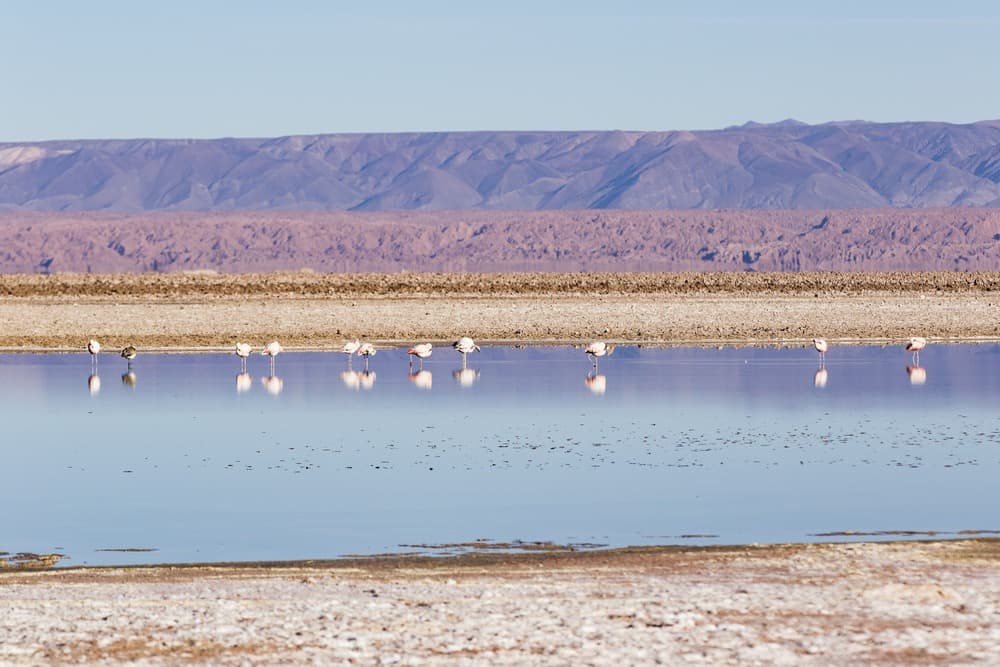
The reserve concentrates, within a single perimeter, several of northern Chile's most iconic landscapes: salt marshes at over 4,000 meters altitude, turquoise lagoons ringed by volcanoes, dunes of the Valley of the Moon, pre-Hispanic ruins. Three flamingo species share the brackish waters: the Chilean flamingo (the most pink), the James's flamingo (the palest and smallest) and the Andean flamingo, recognizable by its yellow legs and whitish-pink plumage.
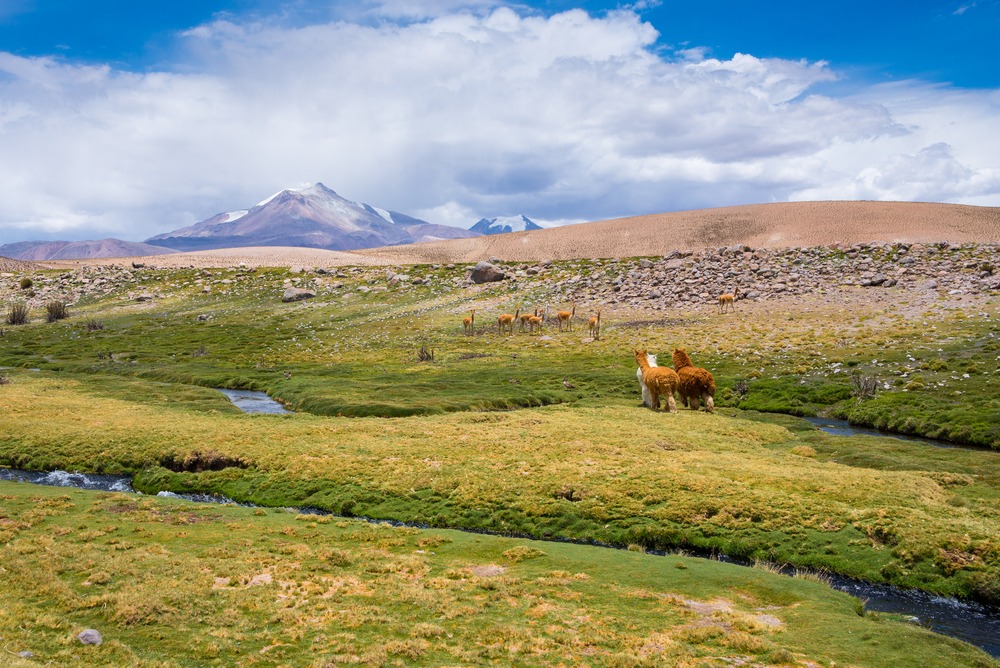
Beyond flamingos, fauna includes vicuñas and llamas near Salar de Tara, rheas in the pampa, Andean condors and viscachas among rocky scree. The Miscanti and Miñiques lagoons also host Andean avocets, white-crested ducks and great horned owls.
History and creation of the reserve
Los Flamencos was established in 1990 to protect the biodiversity of the Atacama Desert, one of the planet's most arid ecosystems. Its area reaches 740 square kilometers, spread across rugged terrain where salt flats are set within a mountain chain peaking at 5,000 meters altitude. The reserve is divided into seven distinct sectors, each with its own ticketing and access.
The territory also preserves ancient human memory, evidenced by the Tulor site, one of the oldest structured villages in northern Chile.
What to see in the reserve
The Miscanti and Miñiques lagoons
Located south of Socaire, these two high-altitude lagoons offer striking visual contrast between deep blue water, mineral shores and volcanoes in the background. This is one of the sectors where flamingo observation is most accessible, accompanied by other high-altitude birds such as the Andean avocet.
Lagoon Chaxa
Integrated into the Atacama Salt Flat, Lagoon Chaxa is one of the most important concentration sites for Andean flamingos. It also serves as a departure point for hiking to Salar de Tara. Rheas sometimes allow themselves to be observed in the surrounding scrub.
Salar de Tara
At 4,500 meters altitude, Salar de Tara remains one of the reserve's least frequented sectors. Volcanic cones emerge from the desert, locally nicknamed the "cathedrals of Tara." The Licancabur volcano and the Zapalieri river structure the horizon. The altitude requires prior acclimatization in San Pedro.
Valley of the Moon
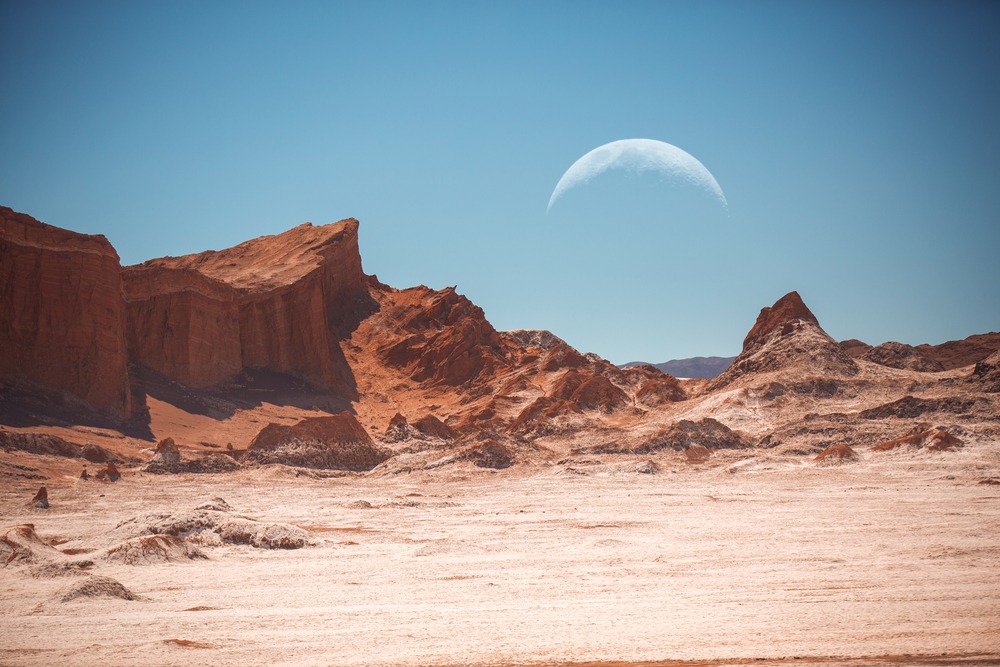
13 km from San Pedro de Atacama, the Valley of the Moon corresponds to a depression 500 meters in diameter carved by wind erosion. The landscape, streaked with sedimentary rock and salt crystals, takes on orange hues in late afternoon. This is the reserve's most visited sector, favored in late afternoon.
Aldea de Tulor
Near the Valley of the Moon, Aldea de Tulor is a prehistoric village uncovered in 1958 by Belgian Jesuit Gustavo Le Paige. Dated to around 800 BC, the site preserves remains of round earthen huts, testifying to ancient human occupation of the desert.
Practical information
- Organization: the reserve is divided into seven sectors with independent ticketing for each. Plan for multiple entries if you combine several sites in the same day.
- Fees: moderate individually, but cumulative. Check locally or with San Pedro agencies for current conditions.
- Transport: a 4x4 vehicle or organized excursion is necessary to reach most sectors, particularly Salar de Tara.
- Altitude: several sites are above 4,000 meters. Plan for two days of acclimatization in San Pedro de Atacama before high-altitude excursions.
- Equipment: high-SPF sunscreen, hat, sunglasses, warm clothing for mornings and evenings, water in quantity.
When to visit
Chilean summer, December to February, remains the most frequented period. Daytime temperatures are mild, but nights remain cool at altitude and brief storms can affect some access routes ("Bolivian winter"). Southern autumn (March-May) and spring (September-November) offer stable conditions, clear landscapes and lighter crowds. Winter (June-August) is dry and luminous, but nighttime temperatures at altitude drop well below freezing.
How to get there
The gateway to the reserve is San Pedro de Atacama, about 1.5 hours by road from Calama airport, itself served by daily flights from Santiago. From San Pedro, the various sectors (Valley of the Moon, Chaxa lagoon, Miscanti-Miñiques, Salar de Tara) are reached by 4x4 or through excursions offered by local agencies. No public transport serves the interior of the reserve.
Nearby attractions
- Lauca National Park: another Andean gem of northern Chile, around Lake Chungará.
- Azapa Valley: cultural and archaeological oasis near Arica, natural complement to a northern circuit.
- Mercado Central de Santiago: typical gastronomic stop before or after travel in the North.
Frequently asked questions
Frequently asked questions
Planning your trip
Los Flamencos Reserve naturally integrates into an itinerary combining the Atacama Desert, the Andean altiplano and, possibly, an extension to Bolivia or southern Peru. To build a tailor-made circuit including San Pedro and northern Chile, consult our trips to Chile.
Interested in this visit?
We can include it in your personalised itinerary.