Easter Island
Easter Island
Located 3,511 km from Chili, Rapa Nui watches over its moai, volcanoes, and a Polynesian people with intact traditions. Our complete guide to planning your visit.
Declared a UNESCO World Heritage site, Easter Island is famous for its deforested landscape and its moai, colossal stone statues left behind by a pre-Columbian civilization. Here's an overview of the island's main attractions.
Easter Island, Where Culture Gazes Upon the Sea
Where do these magnificent sculptures planted facing the ocean come from? They are the undisputed symbol of Easter Island, a volcanic island located in the southern Pacific Ocean, more than 3,000 km from continental Chili. A true sanctuary of peace, isolated from the world, where time seems to have stopped to contemplate the "moai"—statues carved from stone and associated with ancestor worship. Today, the Rapa Nui people safeguard these archaeological ruins that hold profound emotional and sentimental value. Roughly 8,000 inhabitants share Easter Island with seabirds. You'll also observe exceptional sculptural heritage, represented by the rongorongo. Is it a mnemonic device or a writing system before the letter? Your questions will remain unanswered, adding an air of mystery and enigma to your visit.
A Brief History
The Matamua inhabited the island centuries before immigration. Their first chief was named Hotamaka, or Hotu Matu'a. Like pre-Columbian tribes, the Matamua revered ancestors and the forces of nature. To show respect to their forebears, they carved a thousand stone images, using basalt rock, obsidian, or tuff extracted from surrounding volcanoes.
These monolithic sculptures attest to an advanced social organization, which was rare in that primitive era. The "moai," as these funerary sculptures are called, are aligned and placed on ahus—altars where the Matamua made offerings.
Jacob Roggeveen was the first European to set foot on Easter Island. It was in 1722. The Dutch navigator named it Paaseiland, as he discovered it on Easter Sunday. Jacob and his men counted 3,000 inhabitants and more than 1,000 moai.
The Decline of Rapa Nui Civilization
When Frenchman Alphonse Pinart visited the island a century and a half later, he found that the Matamua civilization, once flourishing, had considerably declined. The population had dropped from 3,000 to 111 inhabitants. The forest had been completely razed.
What happened? What caused this downfall? How could a civilization that erected monumental stone sculptures through sheer manual labor collapse so rapidly? Historians propose two hypotheses: the first is ecocide, brought about by civil war, famine, and cannibalism. The second is the arrival of tropical diseases contracted by indigenous people through contact with non-Polynesian peoples.
Starting in September 1988, Easter Island came under Chili's authority. The government took care to restore several "moai" and "ahu."
Today
Nestled in the Polynesian archipelago, Easter Island or Isla de Pascua is a celebrated tourist attraction in Chili. It is known for preserving the artistic and cultural heritage of the Matamua, who inhabited the island since the 13th century. Globetrotters seeking a journey to the end of the world couldn't find better: the island lies 2,074 km from Pitcairn Island and 3,511 km from the Chilean coast. Island isolation has undoubtedly contributed to the preservation of these precious prehistoric remains. The island's inhabitants are called Pascuans.
Visiting Easter Island
Foreigners are the only ones who call it Easter Island. The indigenous people call it Rapa Nui. To earn the friendship of the Pascuans, we recommend saying "Rapa Nui."
Strolling Among the Moai
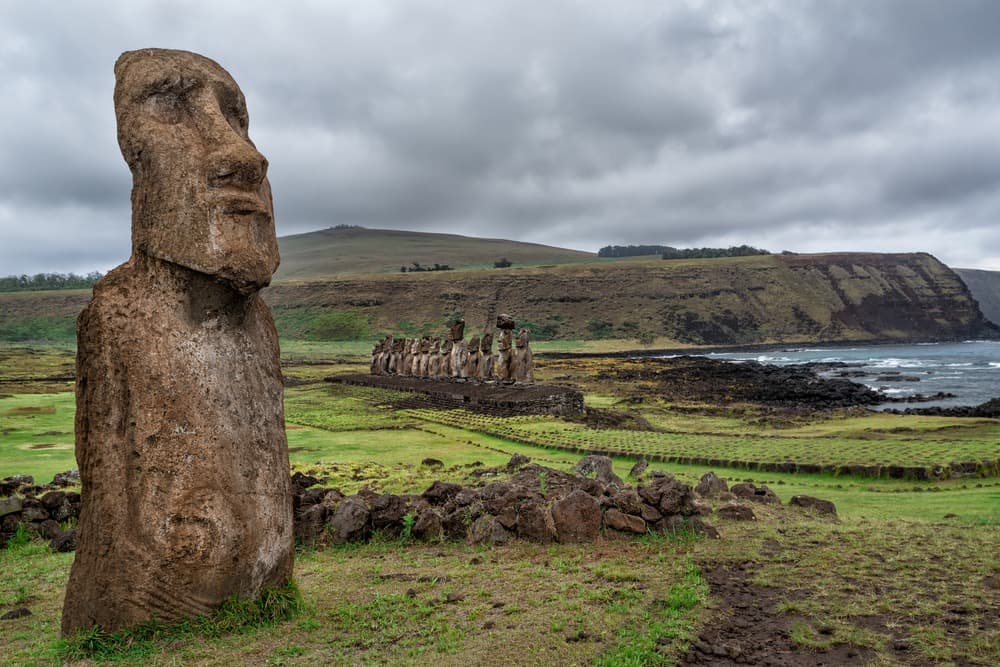
Walking along the beach, you'll encounter rows of stone statues with their backs to the sea. They represent the souls of the deceased. The statues are initially eyeless, with hollow eye sockets. Over time, the Rapa Nui added eyes made of white coral, believing their loved ones had found eternal rest. The statues stand 3 to 9 meters high, though the most monumental ones exceed 10 meters in height and weigh around 80 tons. The statues are in various states: some are buried up to the neck, while others display a clearly visible bust. Ahu Tungariki houses the greatest concentration of moai.
Underwater Diving
Easter Island has remarkable diving spots off the coast. A moai lying on the seafloor captures imaginations. However, it's worth knowing that this moai is not an original work of the Rapa Nui, but rather a replica produced for the film Rapa Nui.
Examining the Rongorongo
During your explorations, you'll observe an impressive series of wooden carvings. The wooden tablets commonly called "rongorongo" are subjects of curiosity. No one knows to this day what purpose they served, whether they represent a set of alphabetic characters or a mnemonic device for remembering genealogy. What we do know is that the descendants of the Matamua continue the sculptural arts to this day.
Connecting with Indigenous Peoples
You can interact with islanders if you wish to deepen your understanding of their beliefs and cultures. The Tapati Rapa Nui Festival is particularly revealing in this regard. The dances, songs, and folk costumes of the Rapa Nui are celebrated during the two-week festival held in February.
The Absence of Forest
The deforestation of the island may surprise you, but it's a direct consequence of the funerary statues. According to humanistic scholars, the Matamua competed in pursuit of prestige to create increasingly larger statues, in both weight and dimension. This desire to outshine neighbors resulted in the overconsumption of available resources. Logs were used to transport the statues. Too many men and women lived on the island, some commentators note. Tree-felling accelerated erosion, which impoverished the soil and correspondingly led to famine. The lush forest gave way to steppe.
Practical Information
When to Visit Easter Island
Easter Island enjoys pleasant temperatures in spring (November and December) and autumn (April and May). Since there are fewer crowds during these months, you can make the most of your vacation.
Entry Fees
Most of the island's archaeological treasures are concentrated in the Rapa Nui National Park. Entry is paid. Each visitor must pay an entrance fee of $80, with children charged at half price.
To reach Easter Island, flying is your only option. Lan Airlines offers a daily flight departing from Santiago and a weekly flight departing from Tahiti. Bring a paperback or a film with you, as the journey takes approximately six hours.
Want to discover this destination?
Our local advisors design your tailor-made trip.