Easter Island
Some 3,700 km from the Chilean coast, Rapa Nui aligns 887 moai across 163 km² of volcanic grasslands swept by Pacific trade winds.
Rapa Nui, as cartographers call Easter Island, ranks among the Pacific's most isolated inhabited points: 3,700 km separate us from the Chilean coast, 4,200 km from the Gambier Islands. The island fits within a triangle of 163 km², drawn by three extinct volcanoes—Terevaka to the north (507 m, the highest peak), Poike to the east, and Rano Kau to the southwest, whose crater holds a lake covered in totora reeds. From Santiago, the LATAM flight takes 5 hours 30 minutes to reach Mataveri, the airport perched at the edge of Hanga Roa, the sole village where the island's 8,000 inhabitants live.
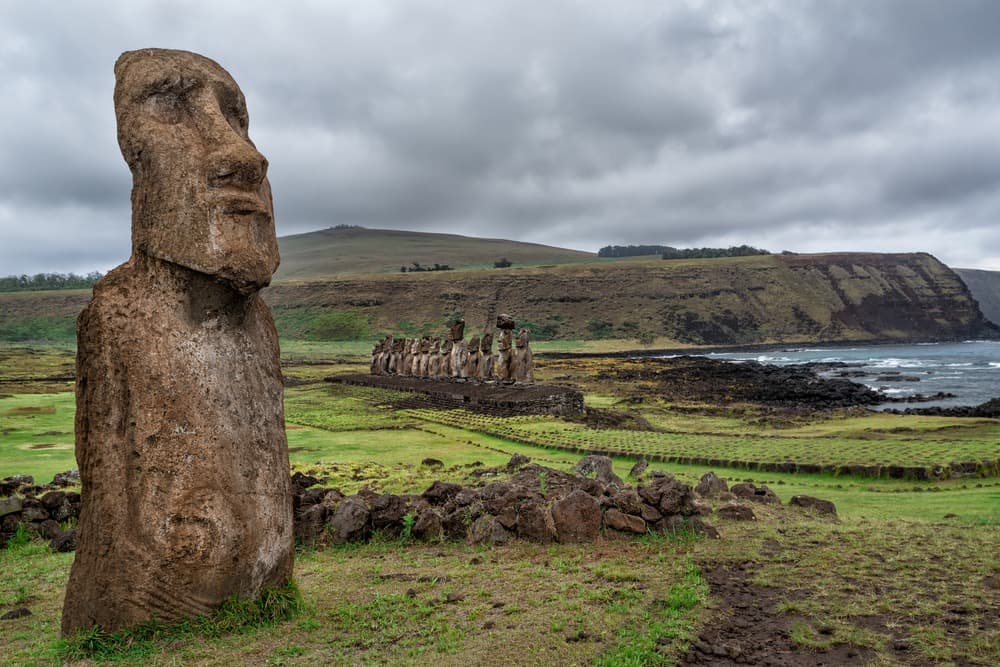
Our team treats Rapa Nui as a destination in its own right, not as a quick add-on to a Chili trip. The landscape defies expectations born from postcards: almost no trees, little dramatic relief, but instead vast grasslands swept by trade winds, black cliffs plunging into the Pacific, and everywhere the ahu—ceremonial platforms that bear the moai. 887 statues have been counted across the island, carved between the 13th and 15th centuries from the volcanic tuff of Rano Raraku. Nearly 400 still rest in this open-air quarry, some barely freed from the stone, others standing on the slopes with their torsos buried in earth.
The Ahu Tongariki site aligns 15 moai facing the ocean, re-erected in 1992 after the tsunami that toppled them. At the island's opposite end, Anakena unfolds a pale coral-pink sand beach, fringed with coconut palms replanted in the 1960s; tradition holds this is where Hotu Matu'a, the founding king from the Marquesas, came ashore. Orongo, perched on the rim of Rano Kau's crater, preserves 53 low stone houses and petroglyphs of the birdman, linked to the Tangata Manu cult that structured island life in the 18th and 19th centuries, after the moai system's collapse.
The Rapa Nui language is still spoken, alongside Spanish, and roughly 60% of residents identify as being of Polynesian descent. Local gastronomy rests on tuna, mahi-mahi, rock lobster, and umu pae, an earth oven in which fish, sweet potato, and taro cook for three to four hours. Each year, two weeks in February host the Tapati festival: spear-fishing competitions, banana-log downhill racing (haka pei), sculpture, songs, and elections of a queen who must prove her knowledge of traditions. If you want to witness this period, book six months ahead—the island has only 1,800 tourist beds.
Economically, Rapa Nui depends on tourism and a special administrative status within Chili. Access to archaeological sites has required, since 2018, purchase of the Rapa Nui National Park ticket (approximately 80 USD), valid for ten days, under strict rules: Orongo and Rano Raraku may be visited only once. This tighter management has eased pressure on the sites, but demands careful planning of your itinerary. Our local agency handles this based on wind and light: Tongariki at sunrise, Tahai for sunset, Rano Raraku mid-morning when tour buses are elsewhere.
To Discover
Sunrise over Ahu Tongariki. The 15 aligned moai stand silhouetted against the orange sky at 7 a.m. in the austral summer, 8 a.m. in winter. We depart Hanga Roa 45 minutes before, thermos of coffee in hand, leaving you there before the other vehicles arrive.
The Rano Raraku quarry. 397 unfinished moai dot the volcano's slopes, from a 21-meter bust still recumbent in the stone to heads emerging at hip height. Allow 2 hours of walking on the marked trail, accessible only once with your park ticket.
Diving and snorkeling at Motu Nui. Pacific waters hold 22–24°C from December through April, with visibility exceeding 40 meters. Basalt depths shelter green sea turtles, groupers, and a submerged moai at 20 meters placed there for a 1994 film shoot.
The Rano Kau crater and cliffs. A 2.5-hour walk from Hanga Roa to the ceremonial village of Orongo, perched on the rim of a crater 1.6 km in diameter whose floor is carpeted by a lake cloaked in totora reeds. Views plunge down to the three islets where terns nested in the birdman cult's practice.
Tapati Festival in February. Two weeks of traditional competitions: haka pei (downhill racing on a banana log at speeds over 60 km/h), fishing, wood carving, dances. Accommodation booking is essential six months in advance.
When to Go
Rapa Nui's subtropical oceanic climate stays mild year-round: 27°C on average from January to March (austral summer), 18–20°C from June to September, with nights rarely dropping below 14°C. Rain falls chiefly in May and June (roughly 120 mm per month), in brief showers that rarely block routes, though they do make the tracks to Anakena and Poike slippery. Wind blows constantly, often at 20–30 km/h, which tempers the sensation of heat even at the height of summer.
Our preferred window runs October through December and March through April: temperatures of 22–25°C, the sea still warm, moderate visitor numbers. January and February draw South American travelers and host the Tapati festival; accommodation prices rise 40–60% and major sites grow crowded mid-day. July and August remain visitable, but the sky clouds over more often and diving loses comfort as water drops to 19–20°C.
Practical Advice
We recommend 4 full nights on-site, making 5 days with flights. This is the time needed to cover three major archaeological circuits (the southeast coast with Tongariki and Rano Raraku, the north with Anakena and Te Pito Kura, the southwest with Rano Kau and Orongo), keep a half-day at sea, and preserve a weather buffer. Three nights remain doable if you concentrate visits, but a rainy day can then jeopardize a major site. Beyond five nights, appeal fades unless you dive daily or insist on experiencing the full Tapati.
Access is by air from Santiago only (daily LATAM service, 5h30), making it a natural pairing with the capital and Central Valley at the beginning or end of your circuit. Many of our travelers chain Rapa Nui with the Atacama Desert: the two destinations oppose each other geographically yet share straightforward air logistics via Santiago. Combining with Chilean Patagonia or the Lake Region remains possible on a 18-day-minimum trip; otherwise internal flight times weigh heavily. The island suits travelers drawn to archaeology and anthropology, moderate walkers (flat to rolling trails, never technical), and divers. Hotel comfort ranges from family-run guesthouses staffed by Rapa Nui families to a few high-end lodges on the west side; we tailor to your budget, knowing island prices run 30–40% above the mainland.